
Chris Rea (1951–2025)The road poet of British blues whose voice, guitar, and restraint defined a singular musical life
Updated: Jan 12
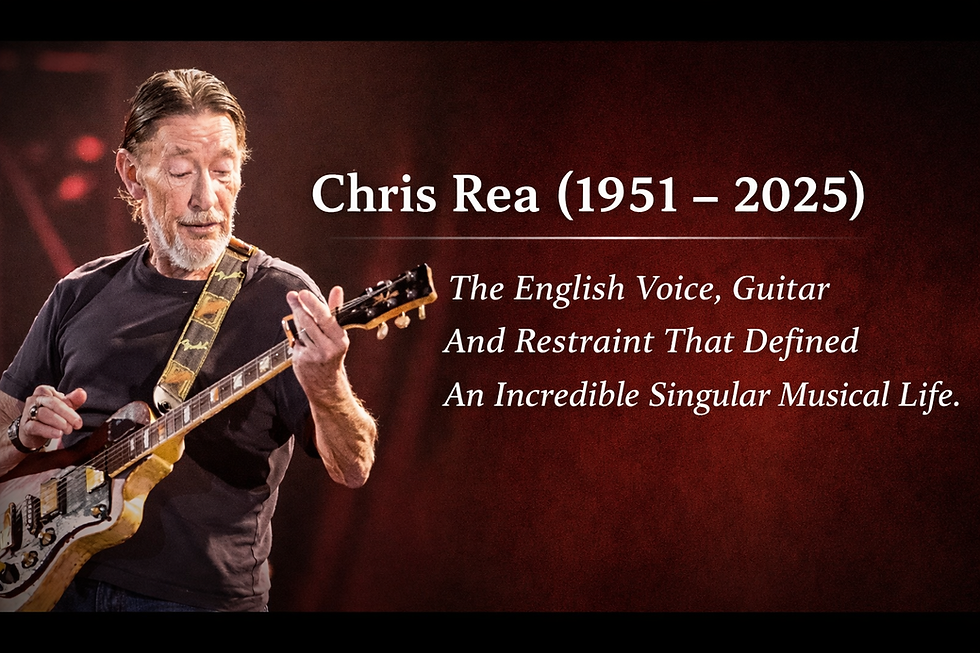
Chris Rea (1951–2025)
The English voice, guitar, and restraint that defined a singular musical life
Chris Rea, the English singer-songwriter and guitarist whose work fused blues tradition with a distinctly British sense of reserve, died on 22 December 2025, aged 74. Revered for his husky, weathered voice and eloquent slide guitar, Rea built one of the most durable and quietly respected careers in European popular music, guided not by fashion or excess but by tone, patience, and emotional truth.
Born Christopher Anton Rea in Middlesbrough, North Yorkshire, he grew up far from the metropolitan centres of the British music industry. The son of an Italian immigrant who ran a successful ice-cream business, Rea did not initially aspire to a musical career. He took up the guitar relatively late, largely self-taught, absorbing American blues, soul, and roots music through records rather than formal instruction. That unconventional path would shape his playing style: instinctive, economical, and deeply expressive.
Rea emerged professionally in the late 1970s, signing with a major label at a time when punk and new wave dominated British culture. His debut, Whatever Happened to Benny Santini?, produced the hit single “Fool (If You Think It’s Over)” and introduced a songwriter of melodic sophistication and emotional gravity. Yet early success came at a cost. Industry pressures to soften his sound and image led Rea to resist, even at the risk of commercial momentum. He later spoke candidly of this period as one of creative frustration, a struggle that hardened his resolve to retain artistic control.
That resolve bore fruit in the early 1980s with a sequence of albums that established his mature voice. Water Sign marked a decisive shift toward atmosphere and introspection, while Shamrock Diaries drew deeply on family history and memory. The latter, often cited as his artistic breakthrough, revealed Rea’s gift for understatement—songs that felt lived-in rather than performed.
With On the Beach and Dancing with Strangers, Rea refined a sound that balanced accessibility with depth. His arrangements favoured space, texture, and mood; his slide guitar spoke in long, mournful lines rather than technical display. It was music that invited reflection, and it resonated widely across Europe.
His defining commercial and cultural moment arrived with The Road to Hell. Inspired by endless motorway journeys and the quiet alienation of modern life, the album captured a national mood at the close of the Thatcher era. Its title track, slow-burning and observational, became one of the most enduring songs of his career, while the album itself topped charts without diluting his identity.
Auberge (Auberge) followed as a work of assurance and warmth, confirming Rea as an artist who had fully mastered his idiom. By this point, he was among Europe’s most reliable touring musicians, known for long, immersive concerts that prioritised feel and connection over spectacle.
In the late 1990s, Rea’s life and career were profoundly affected by severe health issues, including major surgery for pancreatic illness. These experiences altered his relationship with the industry. Rejecting mainstream expectations, he withdrew from commercial cycles and embarked on prolific, self-directed projects, particularly devoted to blues and roots music. Though less visible to casual audiences, this period was marked by artistic freedom and deep personal satisfaction.
Rea was also a painter and visual artist, often designing his own album artwork, and he viewed music as part of a broader creative continuum rather than a commodity. He spoke frequently of tone as truth, believing that a single note, properly felt, mattered more than virtuosity.
Chris Rea’s legacy lies not in reinvention or provocation, but in consistency—a rare fidelity to voice and values across decades. His songs endure because they are unforced: music for travel, memory, and quiet endurance. In a culture often driven by volume and spectacle, he proved that restraint could be radical.
He is survived by his family and by a body of work that continues to accompany listeners on long roads and private journeys—music that does not hurry, and never needs to shout.
Album Highest Recommendations
1. Road To Hell (1989)
2. On The Beach (1986)
3. Auberge (1991)
4. Dancing With Strangers (1987)
5. The Blue Cafe (1998)
6. Shamrock Diaries (1985)
7. Blue Guitars: A Collection Of Songs (2005)
8. New Light Through Old Windows: The Best of Chris Rea (1988)


